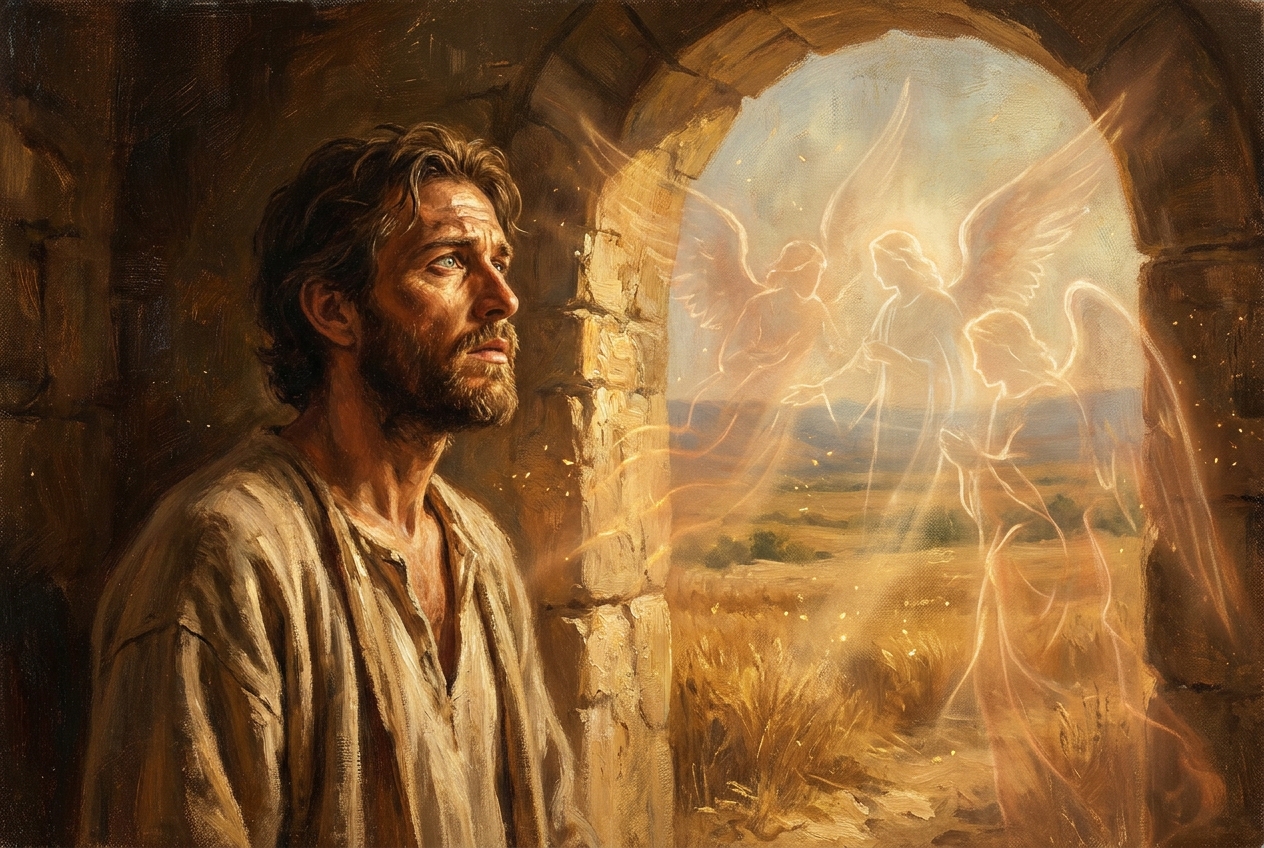
Seeing in the Spirit: What the Seer Gift Actually Looks Like
Most conversations about spiritual gifts stay abstract. This one doesn't.
Blake Healy has been seeing angels, demons, and spiritual activity since he was two years old. Baseball-sized lights drifting to worship music in the back of his parents' minivan. He didn't know it was unusual. It was just the world he lived in. By the time he was nine, the torment started. Three years of nightly fear so severe he couldn't explain it to his parents. By twelve, he found a church that gave him a framework, told his parents everything, and within a week the torment stopped completely.
That's the opening of his conversation with Dan Duval on Discovering Truth, and it sets the tone for everything that follows. This isn't theology from a distance. This is front-line experience from someone who has spent a lifetime learning to work with what God put in him.
Is the Seer Gift an On/Off Switch?
One of the most clarifying moments in this episode comes when Dan asks Blake about the mechanics of seeing in the spirit. A common teaching in charismatic circles is that spiritual gifts only operate when God pushes the button. You're essentially a passive vessel, and when He activates it, boom, you're flowing.
Blake respectfully disagrees. The better metaphor, he says, is a hand that naturally rests slightly open. You can close it completely. You can open it completely. But by default it hangs somewhere in the middle, and it takes intention to hold it all the way in either direction.
Seeing in the spirit works like choosing to focus on a windshield versus through it. The dust and water spots on the glass are always there. You're not imagining them. But you choose whether to bring them into focus or look past them to the road. This reframes the entire gift. It's not passive, it's practiced. Which means it can be developed. And that matters enormously for people who've been waiting for an experience they expect to hit them like a freight train.
What Blake Actually Sees, and What It Reveals
Across the conversation, Blake describes scenes that are striking not because they're dramatic but because of the tenderness behind them.
At a public pool, he watches an elderly woman in a swimcap, inflatable water wings, and foam noodles teaching herself to swim. Her personal angel is standing on the water in front of her, jumping up and down, pumping her fists, shouting go, go, you've got this. The demon behind her wears an expression of absolute terror. Because she decided, at sixty-something years old, that she was done letting fear win. And heaven was treating it like a championship match.
That's the frame Blake brings to the seer gift. Not primarily "spot the enemy." Primarily "understand what God is doing."
He's direct about the risk of the opposite posture: seers who only track demonic activity eventually make that their entire world. What they're actually perceiving may be accurate, but they've camped in the one corner of the spirit realm that produces fear and vigilance rather than partnership with God. The higher operation, as Dan puts it, is seeing from heavenly places. Seated with Christ, addressing what's happening from that vantage point, not from the ground looking up at what the enemy is building.
Can Everyone Develop This?
Blake's answer is yes, with some nuance.
Every spiritual gift, he argues, is available to every believer. Some people are built for high-level gifting in the prophetic or seer realm the same way some people are born athletes. But that doesn't mean everyone else can't swim. His practical steps are simple enough to begin this week:
Ask the Holy Spirit where to look. Look there with your eyes open. Search for large things and small things: full angelic figures, outlines, color sweeps, heat distortion, a flash of light. If nothing registers visually, ask the Holy Spirit to tell you what's there. It may come as an impression, a knowing, or a picture in your mind's eye. Then ask questions. Lord, what was that? Why was that angel standing there and not here?
Building a vocabulary for the spirit realm takes time. Some people see clearly within weeks. Others get impressions for years before anything visual opens up. Blake says this is normal. The mountain is the same for everyone. The angles of approach just differ.
What Wounds Look Like in the Spirit
One of the most practically useful sections of this episode is Blake's description of spiritual wounds, what he actually sees when someone is carrying unaddressed pain.
A fresh wound looks like a clean cut. A healing wound looks slightly red, still tender. An infected wound looks sick, festering. And sometimes he sees devices embedded in the wound, things holding it open, reinforcing it, partnering with the lie the person is believing about what happened to them.
The core counsel is both simple and uncommon: get honest about your wounds, then get help with the ones you can't heal yourself. Not every scratch requires a counselor. But the ones that are getting infected (the bitterness that won't move, the person you can't think about without going cold) those are signs that something needs outside attention. Mothers and fathers in the faith. Trusted community. People who can help you clean it out instead of talking you into pretending it's not there.
Connect with Bride Movement
Learn More