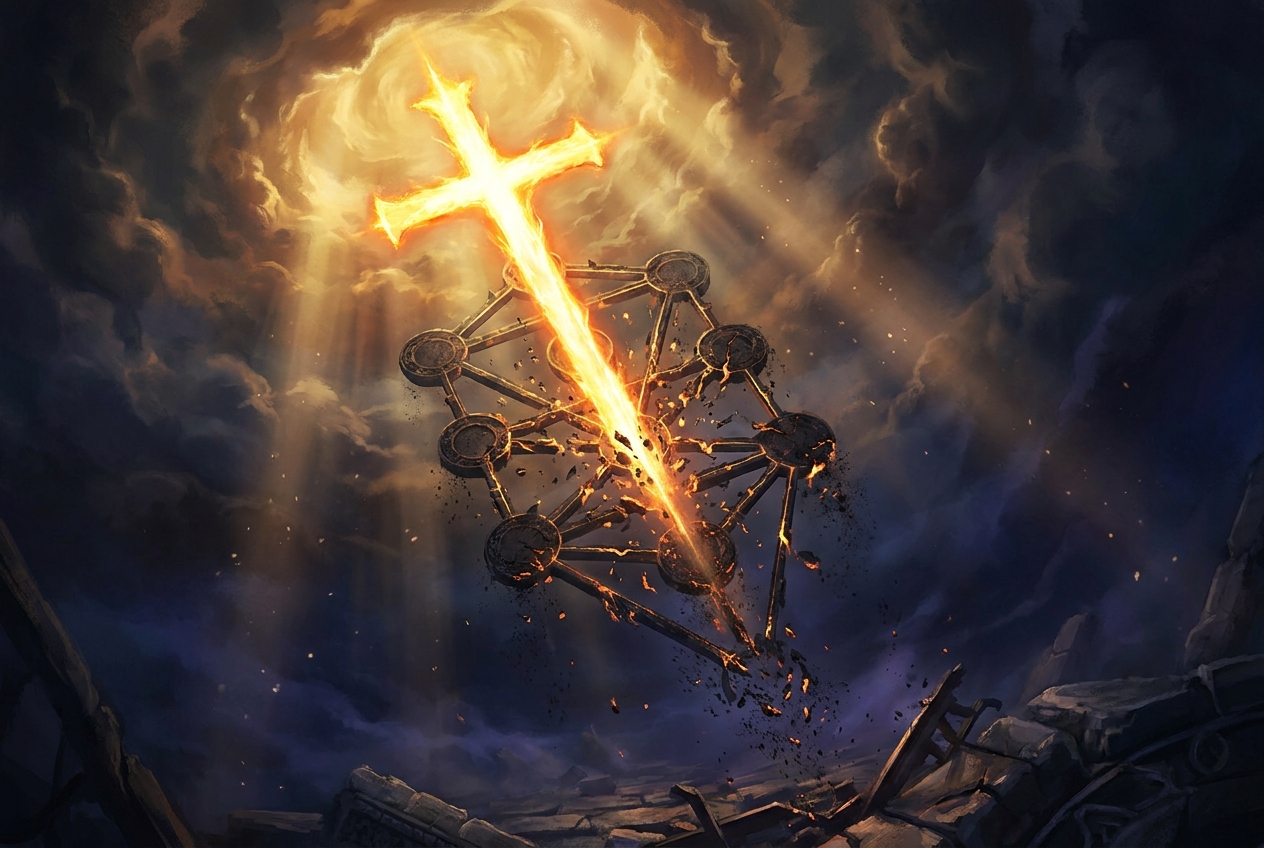
What Is Kabbalah? The Truth Christians Need to Know
Most Christians I talk to assume Judaism is basically the study of the Old Testament. Torah, Mosaic law, and maybe some commentary. That assumption is wrong, and it's costing us.
Kabbalah is described by its own proponents as "the heart of Judaism." It is not a fringe practice or a celebrity fad. It is the deepest stratum of an entire religious tradition, and it sits at the foundation of modern occultism, Freemasonry, Theosophy, and (this is the part that took me years of front-line ministry work to understand) the ritual programming used against survivors of satanic ritual abuse.
That is why I'm teaching this series.
Why I Started Investigating Kabbalah
My introduction to Kabbalah did not come from theology books. It came from working with survivors who were stuck, people I could not help no matter what I tried.
I kept running into something I eventually called "the template." Something was anchored in these individuals at a structural level. I could feel Jesus present in the session, I could identify the problem, and nothing moved. Not living water, not angels, not the name of Jesus at full volume. Nothing.
After years of trying and failing with these cases, I finally identified the structure I was dealing with: the Kabbalistic Tree of Life. The programming was anchored against it. And once I understood that, breakthroughs began.
But to understand the problem, you have to understand Kabbalah itself.
What Kabbalah Actually Is
Kabbalah is defined as the ancient Jewish tradition of mystical interpretation of the Bible, originally transmitted orally and using esoteric methods. Its primary texts include the Zohar (Book of Splendor), the Sepher Yetzirah (Book of Formation), the Book of Mysteries, the Gate of Reincarnations, and a text known as 3 Enoch, which is completely different from 1 Enoch and should not be confused with it.
Here is what Chabad.org, a major Jewish educational resource, says about it: "Kabbalah is the heart of Judaism."
That is not my framing. That is their framing. Detaching Kabbalah from Judaism, in their view, is like picking a flower from its garden. It withers and stinks once severed from its source. They are telling you it is inseparable.
The Thread Running Through Occultism
Here is where the picture comes into focus. When you research Kabbalah seriously, you find the same body of literature cited across every major occult tradition of the last two centuries.
Eliphas Levi, who led the occult revival of the 1800s and revived ceremonial Satanism, was a devoted Kabbalistic student. MacGregor Mathers, co-founder of the Order of the Golden Dawn and mentor to Aleister Crowley, built his entire system on Kabbalistic principles. Helena Blavatsky, who founded the Theosophical Society and whose student Alice Bailey coined the term "New Age" and established the Lucifer Trust, drew heavily on Kabbalah to construct her doctrine of ancient wisdom. Albert Pike's Morals and Dogma, the foundational text of Scottish Rite Freemasonry, calls Kabbalah "the key of the occult sciences."
These are not fringe connections. These are the architects of modern Western occultism, and they all point to the same source.
Is the Zohar Actually Ancient?
One of the selling points of Kabbalah is the claim to ancient wisdom: teachings passed down from Moses at Sinai, containing the hidden keys to creation and scripture.
There is a problem with that claim.
There is no historical record of the Zohar prior to the 13th century. Scholars, including scholars drawing on Jewish academic databases, have placed its likely authorship in 13th-century Spain, written by Rabbi Moshe de Leon and multiple collaborators. The Aramaic it was written in was not widely spoken. It appears designed to create the impression of greater age.
The same texts that modern occultists have used to conjure demonic spirits, unlock Freemasonic initiation, and build programming templates for ritual abuse survivors: those texts cannot demonstrate they predate medieval Spain.
What Are the Ten Sefirot?
This becomes critical in later episodes, so I want to introduce it here.
Central to Kabbalah is the concept of ten Sefirot, described as "expressions of God's being" and "modes through which God relates to the world." The Sefirot include Keter (Crown), Hokhmah (Wisdom), Binah (Understanding), Hesed (Mercy), Din (Justice), Tiferet (Beauty), Netzah (Eternity), Hod (Glory), Yesod (Foundation), and Malkhut (Sovereignty or Shekinah).
When these ten points are laid out spatially, they form what is called the Tree of Life, a structure built from sacred geometry in which the six-pointed star (known in Kabbalah as Metatron's Cube) is embedded at the center.
In ritual magic, this template gets overlaid on the human body. Rituals are performed at specific points to anchor programming, open spiritual portals, and bind individuals to a cosmic structure. That is what I was running into with survivors who could not get free.
Take the Next Step Toward Healing
Start Your Healing Journey